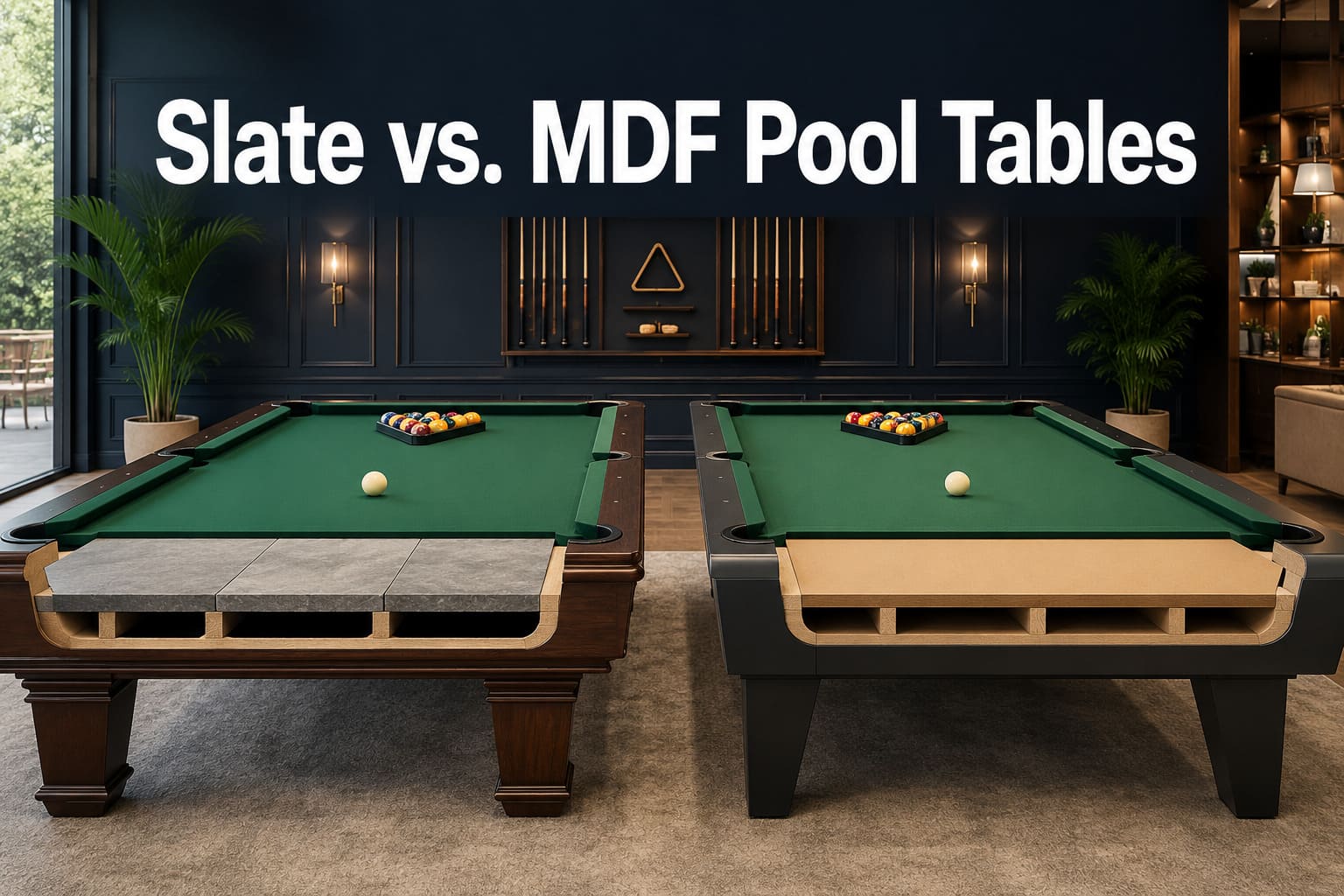
When comparing pool tables, customers may encounter two common playing-bed categories: slate and engineered wood products such as MDF.
The playing bed is the surface beneath the billiard cloth. Its material affects weight, price, installation, stability, accuracy, durability, and the overall playing experience.
Neither option is appropriate for every situation. The right choice depends on the buyer’s expectations, budget, room, frequency of play, and plans for the table.
What Is a Slate Pool Table?
Slate is a natural stone that can be machined into a smooth, flat playing surface.
Quality residential and commercial pool tables frequently use slate because it provides:
- Flatness.
- Weight.
- Stability.
- Consistent ball movement.
- Long-term durability.
- Professional playing characteristics.
Slate tables may use one large piece or multiple matched sections.
Three-piece slate is common because the sections can be transported and precisely leveled during installation.
What Is an MDF Pool Table?
MDF stands for medium-density fiberboard.
It is an engineered wood product manufactured from wood fibers and binders.
MDF playing beds are commonly found in:
- Entry-level tables.
- Recreational tables.
- Lightweight tables.
- Foldable tables.
- Children’s tables.
- Budget-oriented products.
MDF tables are generally lighter and less expensive than slate tables.
Playing Accuracy
Slate is preferred for accurate and consistent play.
Its weight and stability help maintain a flat surface when properly installed and leveled.
MDF may be adequate for casual recreation, but it can be more sensitive to:
- Humidity.
- Moisture.
- Temperature changes.
- Structural movement.
- Long-term sagging.
Serious players are more likely to notice inconsistencies.
Weight and Installation
Slate tables are heavy.
Professional delivery and installation are strongly recommended.
The installers may need to:
- Assemble the cabinet.
- Position slate sections.
- Align seams.
- Install cloth.
- Attach rails.
- Level the table.
- Test the ball roll.
MDF tables are lighter and may be easier to move, but larger models can still require careful assembly.
The lower weight can be beneficial in temporary spaces, upstairs rooms, or properties where mobility is important.
Durability
A quality slate table can provide many years of use when properly maintained.
Slate itself does not warp like wood products, although the table frame, leveling, cloth, cushions, and other parts still require care.
MDF can be affected by moisture. If it absorbs water or experiences prolonged humidity, it may swell, warp, or lose its flatness.
South Florida buyers should pay close attention to indoor climate control and avoid placing an indoor MDF table in an outdoor environment.
Cost
MDF tables generally cost less initially.
They can be appropriate for:
- New players.
- Children.
- Casual family recreation.
- Temporary housing.
- Limited budgets.
- Rooms where a permanent installation is not desired.
Slate tables cost more because of the materials, construction, shipping weight, and professional installation.
The higher cost may be worthwhile for buyers who want long-term ownership, accurate play, premium furniture, and future serviceability.
Appearance and Furniture Quality
The playing-bed material does not determine every aspect of appearance.
Both slate and MDF tables can be offered in attractive designs.
However, premium slate tables often include:
- Solid wood.
- Furniture-grade finishes.
- Custom stains.
- Decorative rails.
- Quality pockets.
- Strong frames.
- Precision hardware.
- Custom cloth.
They are designed to function as both game equipment and major furniture pieces.
Moving the Table
MDF tables are lighter and may be easier to relocate.
Slate tables should be professionally disassembled before moving.
Trying to carry an assembled slate table can damage the slate, frame, and flooring.
If the owner expects to move frequently, the weight and relocation cost should be considered before purchase.
Repair and Service
Many quality slate tables can be serviced over time.
Professional technicians may be able to provide:
- New cloth.
- Cushion replacement.
- Pocket repair.
- Leveling.
- Relocation.
- Hardware replacement.
- Cleaning.
- Restoration.
Some inexpensive MDF tables are not designed for extensive repair. Replacement may be more practical than professional restoration.
Ask about available parts and service before purchasing.
Which Table Is Better for Families?
The answer depends on the family.
An MDF table may be suitable when:
- The children are young.
- The table is for occasional use.
- The budget is limited.
- Portability matters.
- The family is unsure how frequently it will be used.
A slate table may be better when:
- The family wants a permanent game room.
- Adults and experienced players will use it.
- Accurate play matters.
- The table should coordinate with quality furniture.
- Long-term service is important.
Which Table Is Better for Serious Players?
Serious players will generally prefer slate.
Competitive practice requires predictable speed, consistent roll, accurate leveling, and reliable cushion response.
A nine-foot slate table may be selected for tournament-style training, while seven-foot and eight-foot slate tables can provide excellent residential play.
Ask About the Entire Table
Do not judge a table only by the playing-bed material.
Also consider:
- Frame construction.
- Slate thickness.
- Cushion quality.
- Cloth.
- Rail attachment.
- Pockets.
- Levelers.
- Warranty.
- Installation.
- Manufacturer reputation.
- Replacement parts.
- Service availability.
A well-built table is a complete system.
Compare Pool Tables in Person
Boynton Billiards offers a broad selection of pool tables for residential, luxury, competitive, dining, outdoor, and commercial environments.
Visiting a showroom allows customers to compare table sizes, construction, finishes, playing surfaces, cloth options, and overall quality.
A knowledgeable representative can help determine whether the customer needs an entry-level recreational option or a premium slate table.
The best pool table is the one that fits the room, playing expectations, design preferences, and long-term plans.